



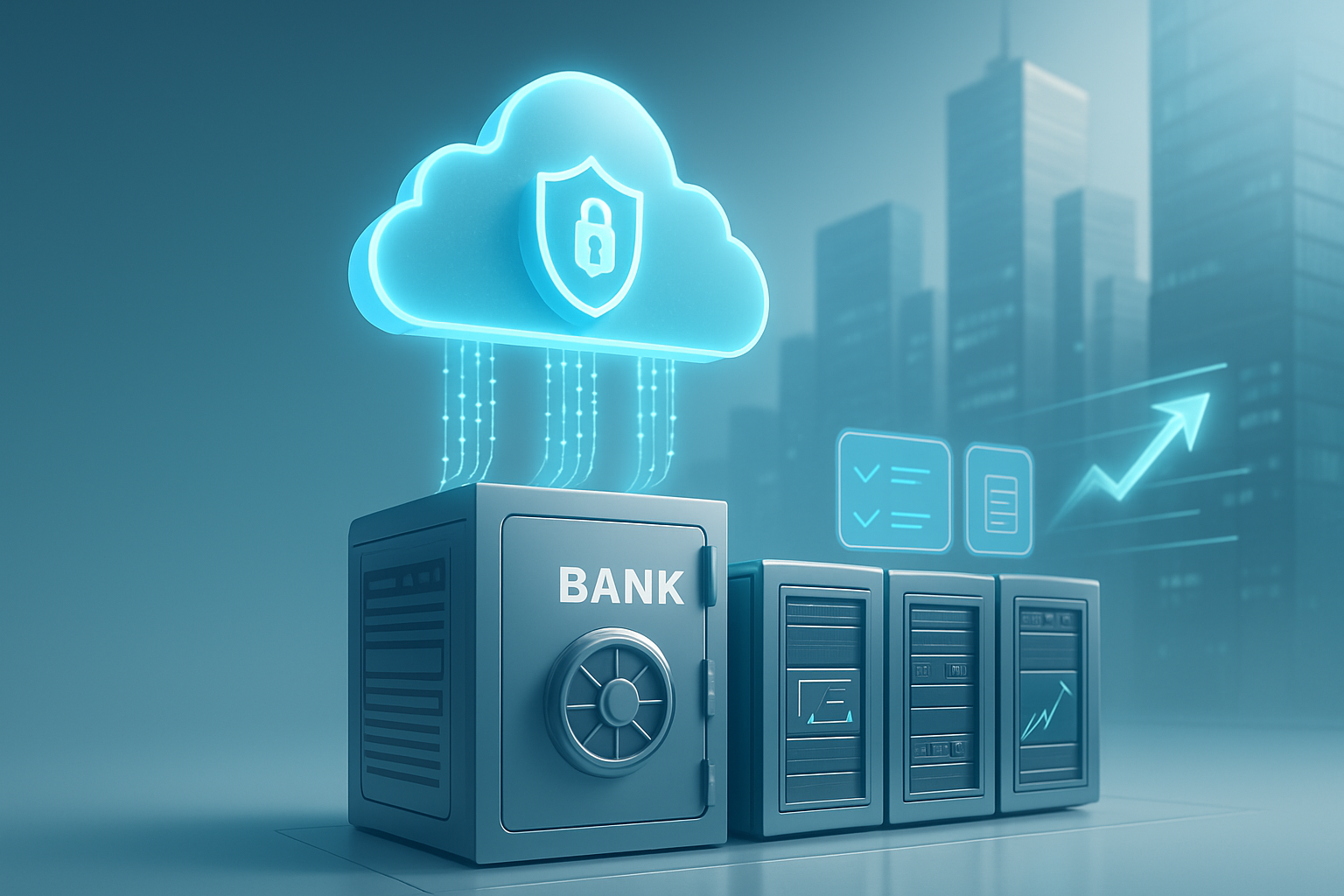
Private Cloud for Banking: Practical, Secure, Compliant
Private cloud is not a retreat from innovation. It is how banks move faster while keeping auditors comfortable and regulators satisfied. With a 165 percent increase in major cyberattacks on financial institutions since 2013 and 90 percent of enterprises rethinking cloud strategy, speed with control wins.
We see institutions accelerate product launches when sensitive data remains in a private environment and elastic analytics run nearby. A mid-tier lender we supported cut onboarding cycle time by 28 percent by placing decisioning engines on a private Kubernetes platform integrated with its core. Deloitte puts it plainly, "Cloud is more than a technology; it is a destination for banks to store data and applications and access advanced software applications via the internet." The point is choice. Private cloud banking gives you it, without sacrificing compliance.
Proven benefits for financial institutions
Private cloud benefits are tangible when aligned to banking realities, not generic IT goals.
Cost and efficiency. Banks usually see 15 to 30 percent lower three‑year TCO versus traditional on‑prem through right‑sizing, automated scaling, and fewer hardware refreshes. We have measured power and cooling savings near 20 percent and a 25 percent drop in infrastructure tickets after SRE practices and self‑service catalogs are in place.
Performance and resilience. Payment engines, risk models, and low‑latency trading prefer proximity. Private cloud placed in-regional colocation next to SWIFT, FIX gateways, or market data feeds trims milliseconds. DR is stronger with policy‑driven replication, active‑active patterns, and clear RPO and RTO targets. Moving from 24‑hour tape restores to 2‑hour failover is common.
Innovation and AI. AI in banking cloud works best when data gravity is respected. Keep PII and PCI zones in a private cluster with governed feature stores. Burst non‑sensitive training to public if needed. Tom Brown of Rackspace said it well, "Private cloud offers a secure, compliant foundation for AI‑ready banking, enabling institutions to innovate faster and reduce risk."
Customer experience. Faster model deployment and event streaming improve personalization without shipping data across borders. That shows up as higher approval rates, fewer false positives, and smoother digital journeys.
Where private cloud reduces cost without risk
Target batch workloads, analytics sandboxes, API gateways, and containerized microservices first. These deliver quick wins in utilization and automation, while core systems remain stable during early phases of banking cloud migration.
Security and compliance that stands up in audits
Financial data governance requires evidence, not promises. Private cloud makes control inheritance explicit and auditable.
Controls and patterns. Enforce zero trust with microsegmentation (NSX, Calico), strong identity (OIDC, MFA, phishing‑resistant FIDO keys), and workload isolation. Use HSMs for keys (Thales, Entrust), KMIP‑compatible KMS, tokenization for PANs, and column‑level encryption. Confidential computing with Intel SGX or AMD SEV helps with model privacy.
Compliance mapping. Pre‑map policies to PCI DSS, SOC 2, ISO 27001, NIST 800‑53, GDPR, GLBA, DORA, NYDFS 500, FFIEC, EBA, and MAS TRM. Private environments let you pin data to a country or region, maintain data sovereignty, and document lawful processing. We automate evidence capture with IaC outputs, CIS Benchmarks, and continuous controls monitoring.
Observability and response. Centralize logs in Splunk or Elastic, wire runtime security with Falco, and use playbooks in SOAR. Tie service SLOs to fraud, payments, and onboarding journeys so risk owners see uptime and error budgets in business terms.
People and process. With 24 percent of firms outsourcing compliance and 43 percent expanding internal teams, operating models are changing. Private cloud aligns with RBAC, change windows, and segregation of duties that auditors already understand.
Evidence banks typically provide in weeks, not months
Automated build logs, golden image attestations, vulnerability baselines, least‑privilege maps, data flow diagrams, and DR test results. Auditors appreciate reproducible pipelines over slideware.
Implementation that delivers value early
The hurdles are real. Legacy mainframes, data gravity, and risk committees that prefer certainty. A staged plan de‑risks outcomes.
Practical steps. 1) Assess workloads, classify data, and pick cloud adjacency patterns. 2) Choose cloud infrastructure for finance that fits regulatory needs: VMware Cloud Foundation, Red Hat OpenShift, Nutanix, Azure Stack HCI, AWS Outposts, Google Distributed Cloud, IBM Cloud for Financial Services, or Oracle Cloud@Customer. 3) Build a landing zone with Terraform and Ansible, network microsegments, HSM‑backed KMS, and a shared services mesh. 4) Create CI/CD with policy gates, blue‑green or canary releases, and immutable images. 5) Migrate with CDC tooling such as GoldenGate or Debezium, validate with synthetic transactions, then cut over with a timed freeze.
Comparison, briefly. Public cloud is elastic and expansive. Private cloud gives the highest control, lowest latency, and clearest data residency. Hybrid blends both. Our rule of thumb. Keep regulated data and systems of record on private. Use public for burst analytics, experimentation, and non‑PII services. Reassess quarterly.
Trusted add‑ons. HashiCorp Vault for secrets, ServiceNow GRC for control evidence, Prisma Cloud or Aqua for container security, and Backstage for developer portals.
Case snapshot. A regional bank with 40 branches moved digital channels and risk scoring to a private OpenShift stack colocated near its core. Result. 18 percent three‑year TCO reduction, login latency down 30 percent, and DR RTO from 12 hours to 90 minutes.
Operationalize with SRE
Define SLAs and SLOs for payments, fraud checks, and onboarding. Use runbooks, chaos days, and quarterly DR tests. Measure toil and retire manual steps aggressively.
Set direction, then move in controlled increments
Treat private cloud as a strategic lever. Start with a 6 to 8 week discovery that maps data classes to controls, models TCO, and picks two candidate workloads. Prove DR, prove compliance, then scale. Institutions that work with specialists for design and governance usually ship faster and audit cleaner.
Frequently Asked Questions
Q: What are the benefits of private cloud for banks?
Private cloud improves control, security, and speed to market. Banks reduce TCO by 15–30 percent, shrink latency, and meet data residency. Start with containerized services, analytics zones, and API gateways to realize quick savings while protecting PCI and PII workloads from unnecessary movement.
Q: How does private cloud enhance security in financial institutions?
It concentrates strong controls where data lives. Banks enforce microsegmentation, HSM‑backed keys, and confidential computing, then automate evidence. Add measured boot, TPM attestation, and immutable images so auditors can verify control operation continuously, not annually. Map policies to PCI DSS, GDPR, GLBA, and DORA from day one.
Q: What are best practices for banking cloud migration?
Start with a landing zone and strict data classification. Use Terraform, CI/CD with policy gates, and change data capture to migrate safely. Pilot two workloads in 90–120 days, validate RPO and RTO, then scale in waves while maintaining segregation of duties and auditable pipelines.
Q: Which private cloud vendors are trusted by financial institutions?
Banks commonly adopt VMware Cloud Foundation, Red Hat OpenShift, and Nutanix. Regulated teams also use AWS Outposts, Azure Stack HCI, Google Distributed Cloud, IBM Cloud for Financial Services, and Oracle Cloud@Customer. Choose based on latency targets, HSM support, data sovereignty, and existing operational tooling.