

Multi-cloud orchestration for IT leaders: a guide
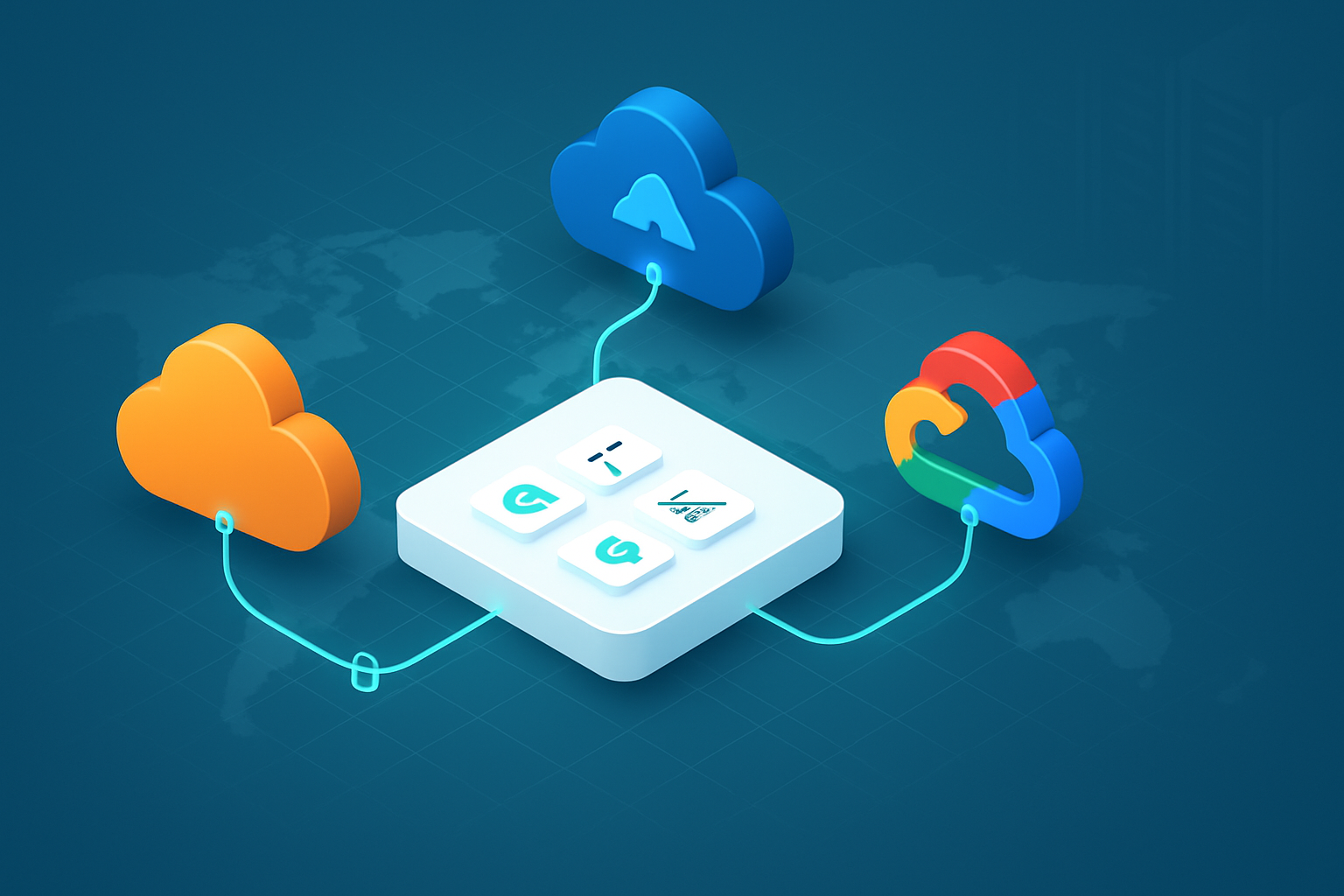
Your cloud portfolio likely grew organically. One team runs Kubernetes on Azure, a data platform lives on Google Cloud, and a legacy stack still depends on AWS managed services. Outages, cost spikes, and audit requests do not respect those boundaries. That is where multi-cloud orchestration earns its keep. It aligns heterogeneous cloud services behind one operating model to improve reliability, cost control, and speed. Deloitte reports 85 percent of businesses use or plan multi-cloud [Deloitte], and 83 percent see better negotiating power. Frost and Sullivan found 75 percent agree a cloud strategy is essential to stay competitive. We have seen orchestration shave weeks off release cycles and cut waste by double digits once governance and automation are in place. The goal is not tool accumulation. It is consistent control planes, automation, and policy that map to business outcomes.
What multi-cloud orchestration means for IT leaders
Multi-cloud orchestration coordinates provisioning, policy, runbooks, and telemetry across providers to reduce vendor lock-in and lift business agility. For leaders, it is a strategy lever, not just plumbing. It connects cloud architecture choices to digital transformation goals, compliance posture, and unit economics. Deloitte notes multi-cloud enables best of breed services [Deloitte]. The trick is deciding where you need uniformity and where provider differentiation is an advantage. Standardize identity, networking, observability, and policy. Let workloads consume native accelerators where they create value, like BigQuery for analytics or AWS SageMaker for specific ML pipelines. The leadership question is simple. Can you move a product feature from idea to production with predictable cost and risk regardless of cloud? If not, orchestration maturity is the gap.
Decision lens
Anchor orchestration scope to outcomes. Target fewer incidents, faster lead time, and cost per transaction. Tie each control plane, from IaC to security compliance checks, to those metrics. We prefer a product-centric platform team that exposes paved roads, not mandates.
Implementation challenges and pragmatic fixes
The complexity argument against multi-cloud is not wrong. It is manageable with the right operating model. Integration across identity, networks, and policy is the heavy lift. We usually start with a 60 to 90 day foundation phase that produces a single onboarding path for new services. A few patterns consistently reduce friction and cost.
Common hurdles and solutions
- Identity and access. Standardize SSO and least privilege with Azure AD or Okta, federate to AWS IAM, GCP IAM, and use workload identity for Kubernetes. Automate entitlements with Terraform and policy guardrails using OPA Gatekeeper or HashiCorp Sentinel.
- Network design. Use hub and spoke with shared services VPCs or VNets, private connectivity like ExpressRoute, Cloud Interconnect, or Direct Connect, and consistent segmentation and DNS. Document cross-cloud egress implications early.
- Cost visibility. Enforce tagging or labels at provisioning. Adopt FinOps practices, showback first, then chargeback. Tools like CloudHealth, Flexera One, Cloudability by Apptio, or CloudZero help drive unit economics.
- Drift and sprawl. Treat everything as code. Use Terraform or Pulumi for infrastructure, Crossplane for Kubernetes-native composition, and GitOps with Argo CD or Flux for app deployments. Block out-of-band changes.
- Security and compliance. Centralize posture management with Wiz or Prisma Cloud. Log to a common lake with CloudTrail, Azure Activity Log, and GCP Admin Activity aggregated into Splunk or Datadog. Map controls to ISO 27001, SOC 2, PCI DSS, HIPAA, or GDPR and test them continuously.
A brief ROI snapshot
In a recent engagement, standardizing IaC modules and GitOps pipelines cut provisioning time from 5 days to same day for 70 percent of requests. FinOps tagging raised cost allocation accuracy from 58 percent to 92 percent in six weeks. Total monthly cloud spend dropped 14 percent after rightsizing and reservation optimization.
Tools and operating model comparison
No single platform does it all. You will blend categories. Choose a primary control plane, then fill gaps. The wrong choice is three overlapping platforms fighting for ownership.
Control planes to consider
- Cloud management platforms. VMware Aria, Flexera One, and ServiceNow Cloud Management give centralized policy, catalog, and cost. Strong for governance and audit, weaker on deep app delivery.
- IaC and GitOps. Terraform, Pulumi, and Crossplane for provisioning, Argo CD or Spinnaker for deployments. High flexibility, requires platform engineering maturity and module standards.
- Provider-native orchestration. Azure Arc, Google Anthos, and AWS Control Tower extend native policy and fleet controls. Fast path to consistency within each vendor’s sphere, varied cross-cloud reach.
- Security and secrets. HashiCorp Vault for secrets, Boundary for access workflows, Prisma Cloud, Wiz, or Lacework for CNAPP. Integrate policy as code into pipelines.
- Observability. Datadog, New Relic, or OpenTelemetry plus Prometheus. Normalize golden signals and SLOs across clouds.
Operating model matters more than the logo mix. A small team will benefit from a CMP plus curated IaC modules. Larger enterprises usually stand up a platform team that treats the platform as a product with SLOs, roadmaps, and clear intake.
Conclusion: orchestration as a leadership discipline
The debate between single cloud simplicity and multi-cloud flexibility will continue. We see multi-cloud orchestration winning when leaders align it to business objectives, not ideology. Industry clouds are accelerating adoption, with 74 percent of leaders calling them necessary [Deloitte]. Expect more AI in orchestration tools by 2025, including predictive scaling and policy anomaly detection. If you are starting, run an assessment against five outcomes, reliability, security, cost, speed, and compliance. Organizations that work with specialists usually compress the journey and avoid brittle designs. Either way, treat orchestration as an evolving product that grows with your business.
Frequently Asked Questions
Q: What is multi-cloud orchestration?
Multi-cloud orchestration coordinates provisioning, policy, and operations across multiple providers. It delivers consistent governance, automation, and observability without sacrificing best of breed services. Start by standardizing identity, networking, and IaC, then layer GitOps and policy as code to enforce controls and reduce manual work.
Q: Which tools are best for multi-cloud orchestration?
The best tools fit your operating model. Terraform or Pulumi for infrastructure as code, Argo CD or Spinnaker for GitOps, and a CMP like VMware Aria or Flexera for governance. Add Vault for secrets, Wiz or Prisma Cloud for posture, and Datadog or OpenTelemetry for unified observability.
Q: How does orchestration improve operational efficiency and cost?
It reduces toil and waste through automation and policy. Standard pipelines cut provisioning time, while FinOps tagging and rightsizing improve unit economics. Expect faster lead times, fewer incidents, and 10 to 20 percent spend reduction after reservation planning, autoscaling, and eliminating idle resources.
Q: What security controls are essential in multi-cloud orchestration?
Enforce identity federation, least privilege, and policy as code. Centralize posture management, unify logging, and mandate encryption at rest and in transit. Use OPA Gatekeeper or Sentinel in pipelines, rotate secrets with Vault, and map evidence to ISO 27001, SOC 2, PCI DSS, HIPAA, or GDPR.